
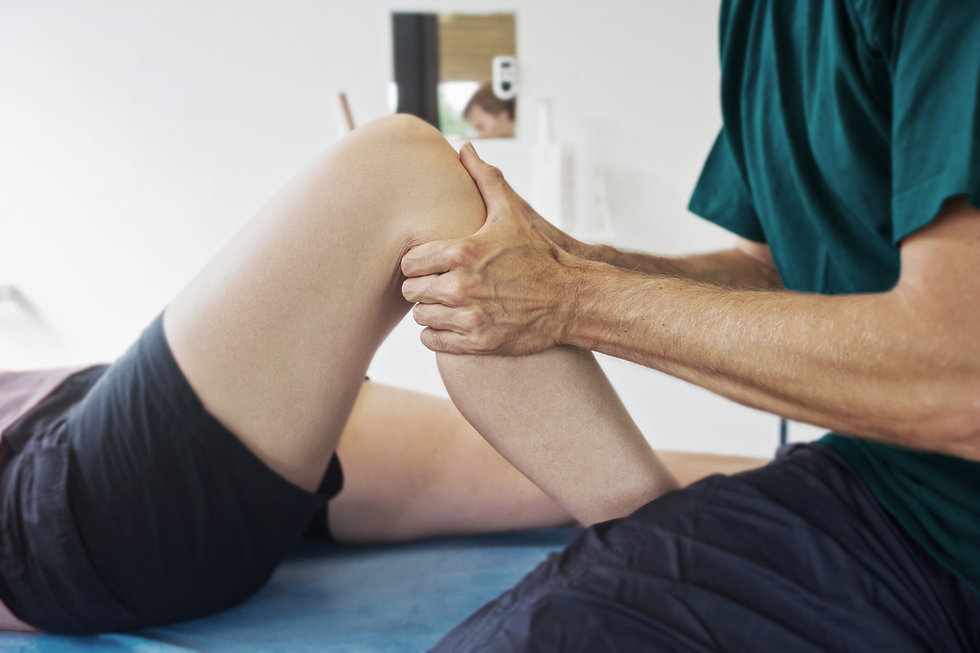
Runner’s Knee
Runner’s knee can cause pain around the front of the knee, behind the kneecap, or around the patella during running, walking, stairs, squats, lunges, cycling, jumping, or prolonged sitting. Physiotherapy may help improve knee alignment, hip strength, ankle mobility, tibia-femur mechanics, running form, walking mechanics, and load management to reduce stress through the knee during repetitive movement.
Runner’s Knee at a glance
✓ Running Starts to Irritate
Often felt with mileage increases, hills, stairs, or speed work.
✓ Hip-Knee Control Matters
Glutes, knee tracking, cadence, and foot mechanics may influence load.
✓ Return to Running Smarter
We assess strength, gait, mobility, and training progression.
What Is Runner’s Knee?
Runner’s knee is a common term used to describe pain around the front of the knee, often near or behind the kneecap. It is closely related to patellofemoral pain, where the kneecap and thigh bone do not tolerate load or track as efficiently during repeated movement.
Although it is called runner’s knee, this condition does not only affect runners. It can affect anyone who performs repeated lower-body movement, including walkers, hikers, gym-goers, cyclists, recreational athletes, dancers, court sport athletes, and people whose work involves stairs, squatting, kneeling, or prolonged standing.
Runner’s knee often develops gradually rather than from one single injury. The pain may begin during longer runs, after increasing mileage, when running hills, during stairs, or after workouts involving squats and lunges. Some people feel pain during activity, while others notice stiffness or aching afterward.
The knee sits between the hip and ankle, so it is heavily influenced by how the entire lower limb moves. The way the tibia, or shin bone, sits in relation to the ankle below, the femur above, and the hip joint is extremely important. If this alignment is off, each step during running or walking may send force through the knee in a less efficient way. Over time, this can make the knee feel compressed, irritated, or “jammed,” especially around the kneecap.
Individuals May Experience
Pain around the front of the knee
Pain behind or around the kneecap
Discomfort when running or walking
Knee pain when going downstairs
Pain with squats, lunges, or step-downs
Stiffness during or after activity
Pain after prolonged sitting
Aching around the knee after exercise
Clicking, grinding, or pressure around the kneecap
Discomfort with hills or uneven terrain
Pain during jumping, landing, or sport
Tightness in the quads, calves, hips, or IT band region
A feeling that the knee is not tracking properly
Reduced confidence with running, workouts, or active movement
Runner’s knee should be assessed if symptoms persist, worsen, cause swelling, locking, giving way, or significantly limit walking, running, stairs, or exercise.
What Contributes to Runner’s Knee?
Common contributing factors include:
Weak hip or thigh muscles
Poor knee tracking during movement
Increased running volume
Sudden changes in running distance, speed, or hills
Limited ankle mobility
Limited hip mobility
Repetitive loading without recovery
Poor foot mechanics or arch control
Poor tibia alignment during walking or running
Femur rotation from weak hip control
Quadriceps weakness or imbalance
Poor glute strength or endurance
Overstriding or inefficient running mechanics
Poor squat, lunge, or landing mechanics
Inadequate footwear or sudden footwear changes
Previous ankle, knee, hip, or lower back injuries
These factors may influence how the knee handles load during movement.
The tibia plays a key role because it connects the foot and ankle below to the knee and femur above. If the foot collapses inward, the tibia may rotate in a way that changes how the knee absorbs force. If the hip does not control the femur properly, the thigh bone may rotate inward or allow the knee to drift toward the midline. When these movements happen repeatedly with every step, the kneecap may not glide as smoothly and pressure may increase through the front of the knee.
This is why runner’s knee is often not just a knee problem. It may involve the ankle, foot, tibia, femur, hip, pelvis, and running mechanics. If the alignment of the lower limb is not efficient, every step can load the knee incorrectly. Over time, that repeated force may irritate the patellofemoral joint and create the sensation of the knee being compressed or jammed.
Why Runner’s Knee Happens During Repetitive Movement
Running and walking involve repeated impact. Every time the foot contacts the ground, force travels upward through the foot, ankle, tibia, knee, femur, hip, pelvis, and spine. If each joint is aligned and moving well, force is distributed more evenly.
When alignment is altered, the knee may absorb stress in a less efficient way. For example:
If the ankle lacks mobility, the tibia may not move well over the foot.
If the foot overpronates, the tibia may rotate inward.
If the hip lacks stability, the femur may rotate inward.
If the glutes are weak, the knee may collapse inward during loading.
If the quads are weak or poorly coordinated, the kneecap may not track smoothly.
With running, this pattern happens thousands of times in one session. Even a small mechanical issue can become meaningful when repeated over and over. This is why load management, strength, alignment, mobility, and running form all matter when addressing runner’s knee.
How Physiotherapy May Help
Physiotherapy rehabilitation focuses on improving movement patterns, lower-limb alignment, strength, mobility, and load tolerance. The goal is not only to reduce knee pain, but to improve how the entire lower limb handles force during running, walking, stairs, squats, lunges, and sport.
Treatment may include:
Strengthening hip and thigh muscles
Glute strengthening to improve femur control
Quadriceps strengthening to support kneecap tracking
Hamstring and calf strengthening when needed
Movement retraining during running and squatting
Gait and running mechanics assessment
Mobility exercises for the ankle, knee, hip, and lower limb
Single-leg stability and balance training
Step-down, squat, lunge, and stair retraining
Load management strategies
Gradual return to running
Education on training volume, hills, speed, and recovery
Footwear or activity modification guidance when appropriate
These exercises help improve knee alignment and reduce stress during activity.
For runners, physiotherapy may also involve reviewing cadence, stride length, foot strike, hip control, knee position, and training progression. For walkers or active individuals, rehab may focus on walking mechanics, stair tolerance, hip and knee strength, and improving comfort with daily movement.
Book an Assessment
If knee pain is limiting your running, walking, stairs, workouts, or sport, our team can assess your movement patterns and guide a targeted rehab plan.
A comprehensive assessment can help identify whether your runner’s knee may be influenced by tibia alignment, ankle mobility, foot mechanics, hip control, femur positioning, quadriceps strength, running form, walking mechanics, or training load.
Related Concerns
Name of Condition